Are Any Lf the British Royal Family a Muslim?
Zaida, a Muslim princess living in 11th-century Seville, is one of the most extraordinary ancestors of the British royal family. Zaida's bloodline reached the English shores through her engagement to Alfonso VI, king of León-Castile. From their offspring descended Isabel Pérez of Castile, who in the 14th century was sent to England to marry Edmund Knuckles of York, son of King Edward Three of England.
Their grandson, Richard, Knuckles of York, led a rebellion against Rex Henry VI which developed into the Wars of the Roses. Richard's 2nd son Edward took the throne in 1461. Thus the legacy of Islamic Kingdom of spain – better known as al-Andalus – establish its way into the Plantagenet imperial court.
This lineage has been of recent involvement both in the Uk and in the Middle East, every bit information technology purportedly proves a family unit relationship between Queen Elizabeth Ii and the Prophet Muhammad himself. Respected experts and commentators such equally Shush's Peerage and Ali Gomaa, the former Grand Mufti of Egypt, accept suggested that Zaida was the offspring of al-Muʿtamid, ruler of Seville and a descendant of the daughter of the Prophet, Fāṭima and her husband ʿĀlī.
As a fellow member of the Hashemite family unit, the descendants of Fāṭima and ʿĀlī, the Queen would count as relatives, among others, the supreme leader of Islamic republic of iran, Ayatollah Ali Khamenei, or the Aga Khan IV, Prince Shah Karim Al Hussaini, a close friend of the electric current Purple family.
Sadly, the theory of the Queen'south Hashemite lineage is too expert to exist true. The mysteries surrounding Zaida'southward origins, the key to the puzzle, brand information technology difficult to sustain her potential right to rule over the realm of Islam.
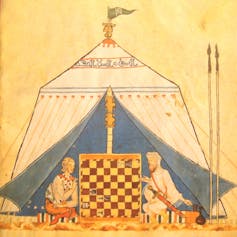
Be that equally it may, there are valuable lessons to be learned from the Queen'due south Spanish ancestor. The story of the wedlock spousal relationship between Zaida and Alfonso VI not only raises questions virtually race, ethnicity and cultural belonging, merely likewise adds dash to explanations of the contact betwixt Islam and the Christian Westward.
A number of recent books and articles have presented the contact between "Las Tres Culturas" – as the Abrahamic faiths are commonly referred to in Spain – in 1 of two mutually exclusive ways. Spain was either a land of tolerance, better known equally "convivencia", or information technology was a theatre of state of war and inter-religious conflict. In fact, Zaida and Alfonso Vi lived in a world which allowed piddling reflection on these modern debates.
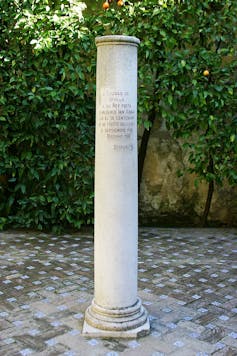
Zaida enjoyed the many luxuries of the court of the ʿAbbādid dynasty of Seville through her marriage to al-Fath al-Maʾmūn, the son of the emir al-Muʿtamid. While the accepted story is that Zaida was the daughter of the emir, recent studies take shown she most likely was an outsider, who gained access into the family's inner circle through this marriage. By the 1040s, the ʿAbbādids supplanted Cordoba equally the most prominent in al-Andalus.
This was a momentous change, since Islamic Kingdom of spain had been ruled by the Umayyad dynasty for almost 300 years. Under the rule of Zaida'south father-in-law, al-Muʿtamid, Seville experienced a "gold age" of culture, attracting famous poets from all corners of the Islamic Mediterranean, including Ibn Hamdis, and even al-Muʿtamid himself.
Zaida'southward capture
In 1091, Seville was captured by the Almoravid troops of Yūsuf b. Tāshfīn, and the emir al-Muʿtamid was exiled to Aghmat, near Marrakech, in Morocco, where he would die soon afterwards, lamenting his own failures in his concluding poems. As Zaida fled from the disastrous Almoravid siege, in which her husband al-Maʾmūn was killed, her fate appeared sealed. In her hurried exit seeking refuge north of Seville, the princess was taken into captivity and sent to the Castilian court in Toledo, where she would find a new life.
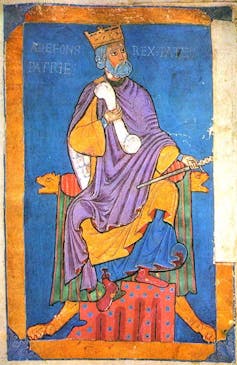
Her future married man, Alfonso VI, had long been a thorn in the side of al-Muʿtamid, particularly after May 1085, when the Spanish ruler seized the bustling city of Toledo from the local Muslim dynasty. Alfonso VI's conquest of Toledo was a serious blow to the hegemony of al-Andalus in Iberian politics, causing panic amongst the different emirs of al-Andalus and fuelling the arrival of the Almoravids north of the Straits of Gibraltar.
Alfonso VI aspired to become the sole ruler of the Iberian Peninsula, including the Islamic territories. According to the 13th-century Tunisian chronicler, Ibn al-Kardabūs, the big-headed Castilian ruler even started to fashion himself as the "Emperor of the Two Religions". In this context, the decision to welcome Zaida at the Castilian court – instead of sending her to Morocco to her relatives in exile – and Alfonso's sexual human relationship with the Muslim princess, was non as a sign of coexistence, but a confident statement of ability.
Conversion to Christianity
Zaida's position at the court was as poorly understood by Christian contemporaries in Kingdom of spain as it is today. Some texts refer to her as a concubine; in fact, according to Pelayo, the famous bishop of Oviedo, Zaida was "nearly his wife". And if the presence of the Muslim princess at court might take been a touchy bailiwick in itself, Alfonso VI'south decision to make Zaida his legitimate spouse was even more perplexing.
The birth of Sancho, Alfonso VI'south just son, was the determining factor. Zaida so converted to Christianity, taking the same name, Isabel, later used by her famous descendant. Zaida's bedchamber, which had been so important in her rise to royal favour, also saw her fall. The princess died giving birth to one of the other two children she conceived with Alfonso Vi while acting as Queen consort.
Queen Elizabeth II'southward ancestors transgressed their religious, cultural and political boundaries in ways which are now difficult to classify. At the same time, the story of Zaida's union to Alfonso VI is a reminder of the intimate and profoundly circuitous interlacing of our common Islamic and European pasts.
Source: https://theconversation.com/meet-the-muslim-princess-zaida-spanish-ancestor-of-the-british-royal-family-96567
0 Response to "Are Any Lf the British Royal Family a Muslim?"
Post a Comment