Hyde Parks Art Center Bill Walker Urban Griot Press Release
A new exhibition looks at rare works of art that are powerful and sometimes graphic. The historic piece of work was made past an artist with a strong connexion to Chicago public art.
Pecker Walker was a muralist on a mission to display beauty and civilization, merely he also reflected on the harsh realities of life on the streets.
We have a look inside the showroom "Bill Walker: Urban Griot" at the Hyde Park Fine art Center through April 8, 2018, part of the Terra Foundation for American Arts' Fine art Design Chicago Initiative.
TRANSCRIPT
Phil Ponce: There are positive portraits of happy families, and threatening images of street life and despair.
At the Hyde Park Art Center, a selection of rarely seen works is on display.
They were created by Neb Walker, who once stated: "The artist and his art are warning human being of the dangers ahead."
Juarez Hawkins, curator: In a lot of these images y'all'll see pics of children and they're sort of bearing witness to a lot of the carnage or the violence that's going on, so in a way he's saying "I'k gonna keep this existent, because this is where I alive." He lived in these areas, and then "I live here, this is my lived experience, and I see these children all around me" and it's their lived experience also.
Ponce: This exhibition of Walker's art from the 1970s and '80s is called "Urban Griot."
Hawkins: In Due west African civilization the griot is the person who passes on the culture. Frequently if you're dealing with cultures that don't have a written language, the fashion you pass on the legacy and history of a given tribe or culture is through the storyteller or the griot, and he or she would be the keeper of the stories that are continued to laissez passer on throughout the generations. So I looked at the work and I felt it was in that aforementioned vein, this idea of someone telling a story that was very topical and relevant in the '80s, but interestingly enough it'due south however topical and relevant even today.
Ponce: The pictures are often cautionary tales, created by an artist concerned about the plight of his neighbors.
Hawkins: Basically the work is divided into three primary series. The beginning serial is called "For Blacks Merely" and a lot of it was directed at the blackness customs. It was a way of proverb, "Hey, look at what's happening in our communities, the violence, the gangs, the drugs. Perchance we as a community should concord ourselves accountable too for the state of our diplomacy. At the very to the lowest degree, exist enlightened of what's going on and non exist bullheaded to information technology."
The second series is called "Reaganomics" and that'due south dealing with the economical bear on of Reagan's policies on the poor. We hear a lot about the revenue enhancement breaks and so on ... and a lot of social services were cut, and it really had a devastating impact on communities of colour.
The third one is chosen "Red White and Blueish, I Dear Yous." So you see some of the aforementioned problems of drug habit, violence, that we see in the other series, merely they're all rendered in red, white and blue, and then it's sort of giving this polite nod to say, "Hey this country is having a lot of problems, but I'm even so a patriot. I served my country, and I still love this country so we're trying to hold out a footling hope."
But once more continuing to show the earth and showing people, "Hey this is not right. We need to accept steps to changing information technology. The first step in getting dirty laundry clean is to bring it out of the hamper and bring it into the air and the light."
Ponce: Walker fabricated a name for himself in public art.
He was the driving force behind the historic mural, the Wall of Respect, which debuted in 1967 at 43rd Street and Langley Avenue.
Hawkins: The idea was i, to bring dazzler into a really crude neighborhood. Some people chosen that neighborhood "the saucepan of claret" because of gang violence and poverty, so it was about bringing beauty, but it was also a sense of history. Part of the impetus was to show the community, to show its children all of this wonderful black energy and blackness pride.
Ponce: The curator of this exhibition had a personal connection to the wall.
Hawkins: My mother, Florence Hawkins, was one of the painters of the Wall of Respect. She was a member of the customs. We lived right around the corner on Champlain. And so oftentimes he welcomed people from the community. He was known for interacting with people in the neighborhoods that he worked in, and my mother just saying, "Oh you guys are painting something, this looks cool, I'yard an creative person, can I play?" and they gave her a brush.
Ponce: Much of the work in the exhibition comes from Chicago State University. Different his usual sheet of brick and physical, Walker created these on newspaper, newspaper, even Plexiglas.
Hawkins: He felt that truth—and as an creative person speaking the truth—that was one way of helping mankind sort of stave off his own devastation … in terms of just saying, "Hey we're not gonna pull back, because this is the reality that many of u.s.a. are dealing with."
And so as such we can't afford to just exist inured to what's around us, just because information technology seems to be a fashion of life. We accept to ascension up, we have to interact, we have to cooperate and make positive alter.
Related stories:
 'Race' Exhibition Challenges Visitors to Rethink the Concept
Nov. xiii: What does race mean to you? A new exhibit at the Chicago History Museum asks visitors to consider how much all of us focus on race every day, whether we realize it or non.
 Hebru Brantley'due south New Art Show Takes Flight in Elmhurst
Sept. xx: His artwork is in the collections of George Lucas, Jay-Z and Mayor Rahm Emanuel. We get a preview of the show "Hebru Brantley: Forced Field" at the Elmhurst Art Museum.
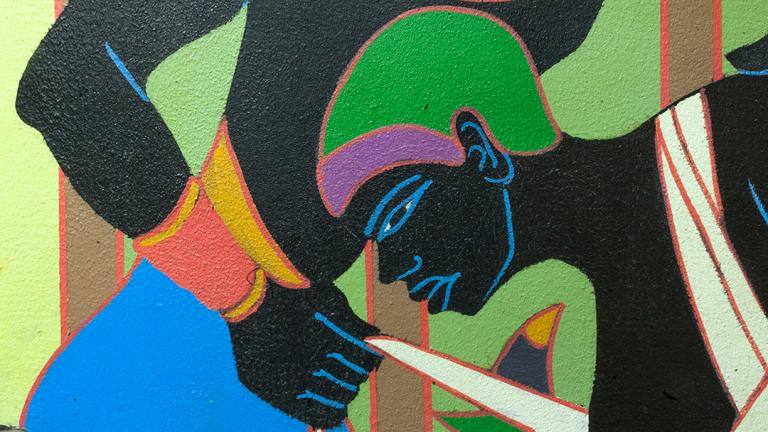 Monumental Exhibitions Open Doors to Chicago History
March 2: Two new shows at the Chicago Cultural Center open doors to a local arts movement from 50 years agone.
Source: https://news.wttw.com/2017/11/15/cautionary-tales-city-life-chicago-painter-bill-walker
0 Response to "Hyde Parks Art Center Bill Walker Urban Griot Press Release"
Post a Comment