This Art Class Is Recreating the Faces of Unidentified Migrants
/https://tf-cmsv2-smithsonianmag-media.s3.amazonaws.com/filer/10/7d/107d0e26-39be-48cb-83ea-5c467eb74ed8/forensic18-photo-2.jpg)
Every year, hundreds of migrants traveling across the Mexican border die while attempting to cross into the United States. The conditions of Arizona, Texas and New United mexican states, and the risky nature of the journey, tin can cause the individuals to die by heat stroke, hyperthermia due to exposure to the elements and aridity.
Their bodies are not easy to identify. Though medical examiners try DNA and dental comparisons, many migrants go unidentified.
Recently, however, students at the New York Academy of Art helped a Tuscon, Arizona, medical examiner's office accept a step toward naming some of the nameless past reconstructing the faces of 8 migrants.
As Patricia Leigh Brown reports forThe New York Times,the workshop, taught by forensic creative person Joe Mullins of the National Center for Missing and Exploited Children, is part of a pilot program recreating faces from the remains of the individuals who were discovered in the desert.
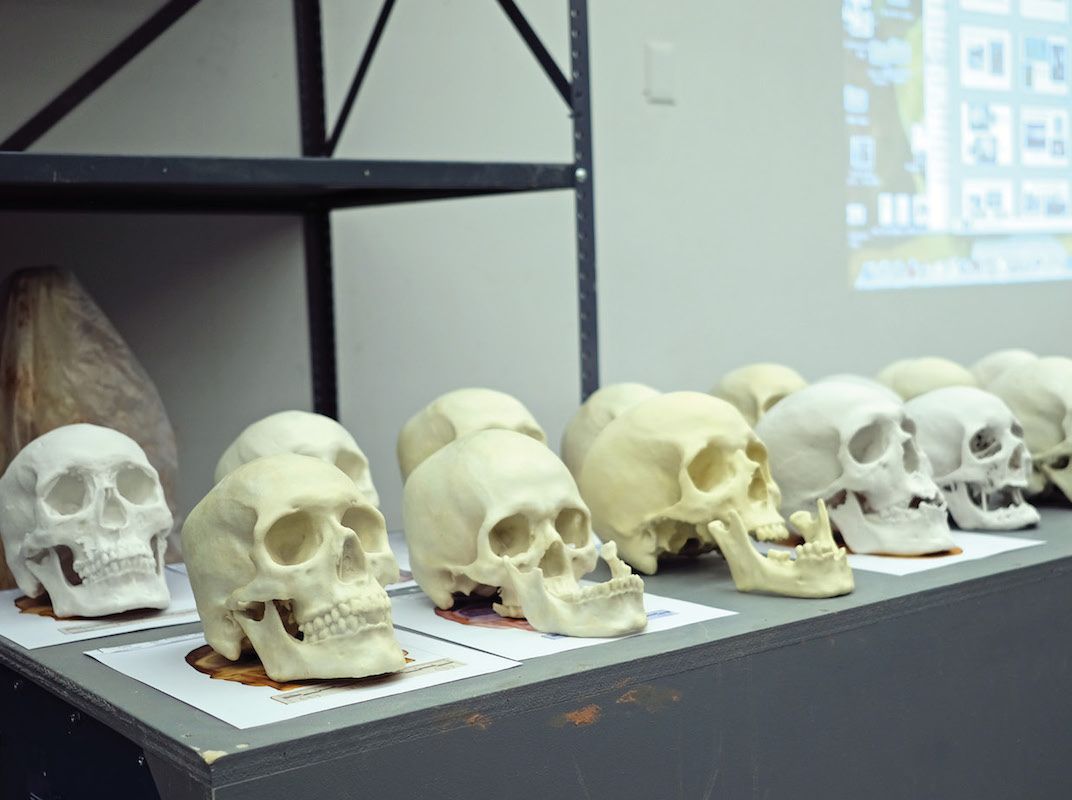
According to Brownish, CT-scans of migrants' skulls were used to create 3D-printed replicas. The New York University of Art students, who are trained in anatomy, used whatever context they might know from the Pima County medical examiner, similar an estimate of the migrant's age, to rebuild the person'south muscles and soft tissue layer with clay. Tissue depths, which the students marked using cut plastic straws placed on the dirt, were based on researchers' guesses for age, gender and cultural background.
The reconstructions have marbles for eyes and a marker to dot the pupils.
The project is part of the growing field of forensic facial reconstruction, which combines scientific discipline, fine art and anthropology to help solve crimes or mass disasters.
According to the press release, the New York Academy of Art course was created in 2015 in a partnership with the New York City Office of the Medical Examiner. In its offset year, student created 11 busts from New York City skeletal remains, resulting in i positive identification. In 2016, the plan expanded to include skulls from cold cases around the country.
Facial reconstruction equally a ways of identifying lost persons is not a new art. In fact, the showtime scientific reconstructions date back to 1895, when German anatomist Wilhem His modeled a bust onto the plaster cast of the skull of Johann Sebastian Bach. Soon after, in 1916, an unidentified skeleton found in a Brooklyn residence was confirmed as the remains of a man named Domenico La Rosa after an artist, using a medium called "plastelina"—where colored plasticine was molded over the bones of the face—allowed the sister of the missing person to identify La Rosa's remains.
The technique has come a long way since then, with today'south reconstructions achieving incredibly lifelike results. While reconstructions are oftentimes employed past forensic specialists, they're also used by archaeologists hoping to better empathise early humans. This Jan, for instance, the reconstructed face of an 18-yr-onetime woman who lived some 9,000 years ago was unveiled at Hellenic republic'south Acropolis Museum.
In forensic use, new 3D technology has minimized degrees of errors, researchers accept found. When DNA and dental exams fail and a face tin't be identified due decay, that'southward when facial reconstruction steps in.
While facial reconstruction is a last-resort for identifying unknown persons, it's nevertheless an important resource. According to the press release, at that place are currently thousands of skeletal remains waiting identification.
Every bit it happens, two of the eight migrants educatee reconstructed have already been identified independent of the project thank you to Deoxyribonucleic acid tests and family unit members. For the other six reconstructions created by the course, they but might provide the recognition someone needs to identify a body and bring some closure to those the individual left behind.
View all viii recreations at the website of the National Establish of Justice'due south National Missing and Unidentified Persons Arrangement, NamUs.
Source: https://www.smithsonianmag.com/smart-news/help-identify-migrants-who-died-along-border-art-class-reconstructs-their-faces-180968343/
0 Response to "This Art Class Is Recreating the Faces of Unidentified Migrants"
Post a Comment